
Complete Guide to Omni-Directional Antennas: Working & Applications
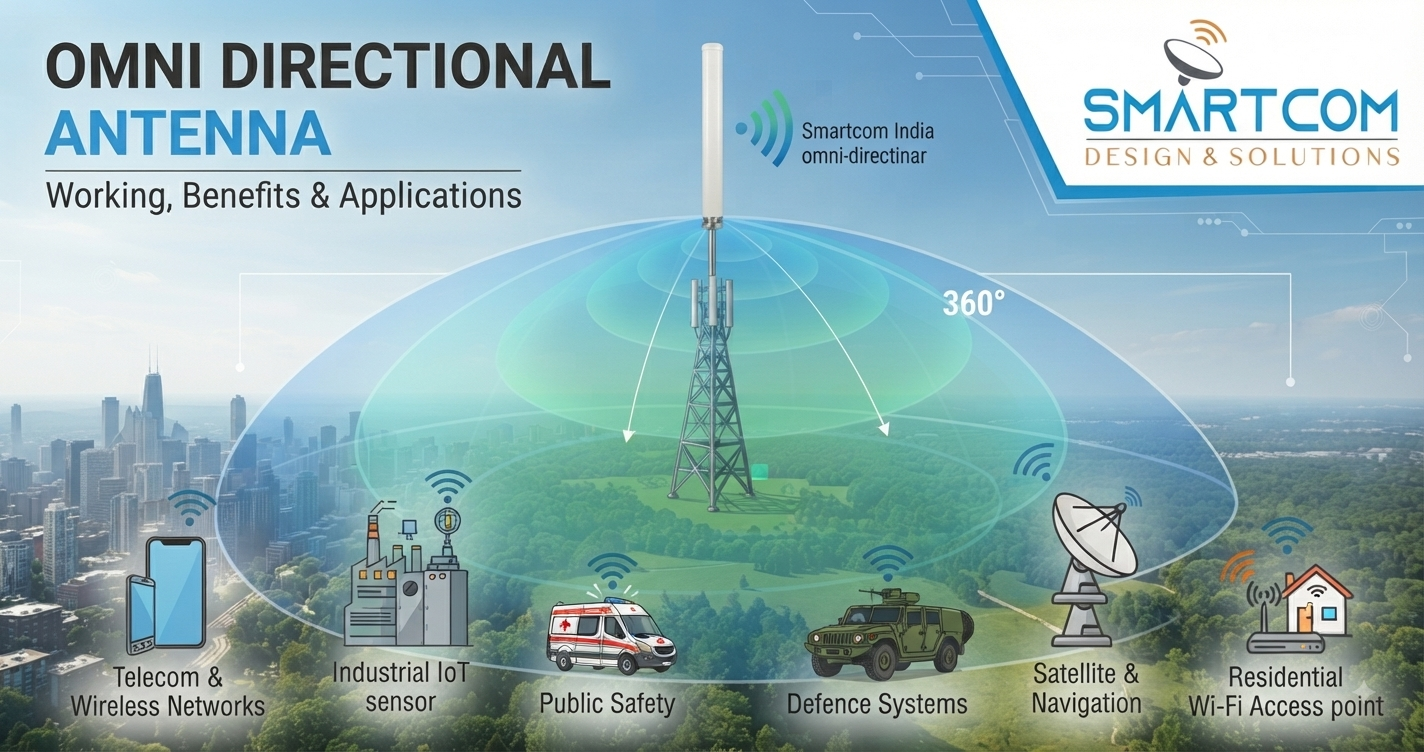
An omnidirectional antenna is designed to transmit and receive radio signals across a broad 360-degree area in the horizontal plane. Unlike a directional antenna, it does not focus RF energy mainly in one direction.
This makes an omni antenna useful when communication devices are located around the antenna. It is commonly used in telecom, wireless communication, IoT, public safety, defence and other RF applications.
Smartcom India provides standard and customised omni antenna solutions for different frequency bands and application requirements.
What Is an Omni-Directional Antenna?
An omnidirectional antenna radiates RF energy around the antenna in the horizontal plane. Its radiation pattern is commonly described as 360-degree coverage.
However, 360-degree coverage does not mean the antenna provides the same signal strength at every angle. Performance depends on antenna design, gain, frequency, installation height, surroundings and other RF system conditions.
The main advantage is that devices do not need to be positioned directly in front of the antenna.
How Does an Omni Antenna Work?
1. RF Signal Is Supplied
A transmitter sends an RF electrical signal to the antenna through a suitable transmission line.
2. The Antenna Radiates the Signal
The antenna converts electrical energy into electromagnetic waves and distributes RF energy around the antenna in the horizontal plane.
3. Receiving Devices Pick Up the Signal
A receiving device detects the electromagnetic energy and converts it into an electrical signal for further processing. The same principle works in reverse when the antenna receives a signal.
Key Advantages of an Omnidirectional Antenna
Wide Horizontal Coverage
An omni antenna provides broad coverage around the antenna, making it suitable when users or devices are located in different directions.
No Precise Directional Alignment
Unlike directional antennas, an omni antenna generally does not need to be aimed toward a specific target.
Suitable for Moving Devices
Broad coverage can be useful when users or devices move around a coverage area, including certain IoT, industrial and wireless communication applications.
Multiple Frequency Options
Omni antennas are available for different frequency requirements. Smartcom’s current range includes VHF, UHF, GSM, L-band, S-band and higher-frequency options, with custom frequency combinations available.
What Affects Omni Antenna Range?
The range of an omnidirectional antenna depends on the complete RF system. Important factors include:
- Operating frequency
- Antenna gain
- Installation height
- Transmitter power
- Receiver sensitivity
- Cable and connector losses
- Buildings and other obstacles
- Surrounding environment
Therefore, antenna range should be evaluated according to the actual application rather than the antenna type alone.
Where Are Omni-Directional Antennas Used?
Common applications include:
- Telecom and wireless networks
- Industrial IoT and remote monitoring
- Public safety communication
- Defence communication systems
- Wireless data communication
- Navigation and satellite-related systems
- Telemetry systems
- Wireless infrastructure
Smartcom’s broader RF antenna solutions cover applications including telecom, public safety, industrial IoT, navigation and satellite links.
Omni Antenna vs Directional Antenna
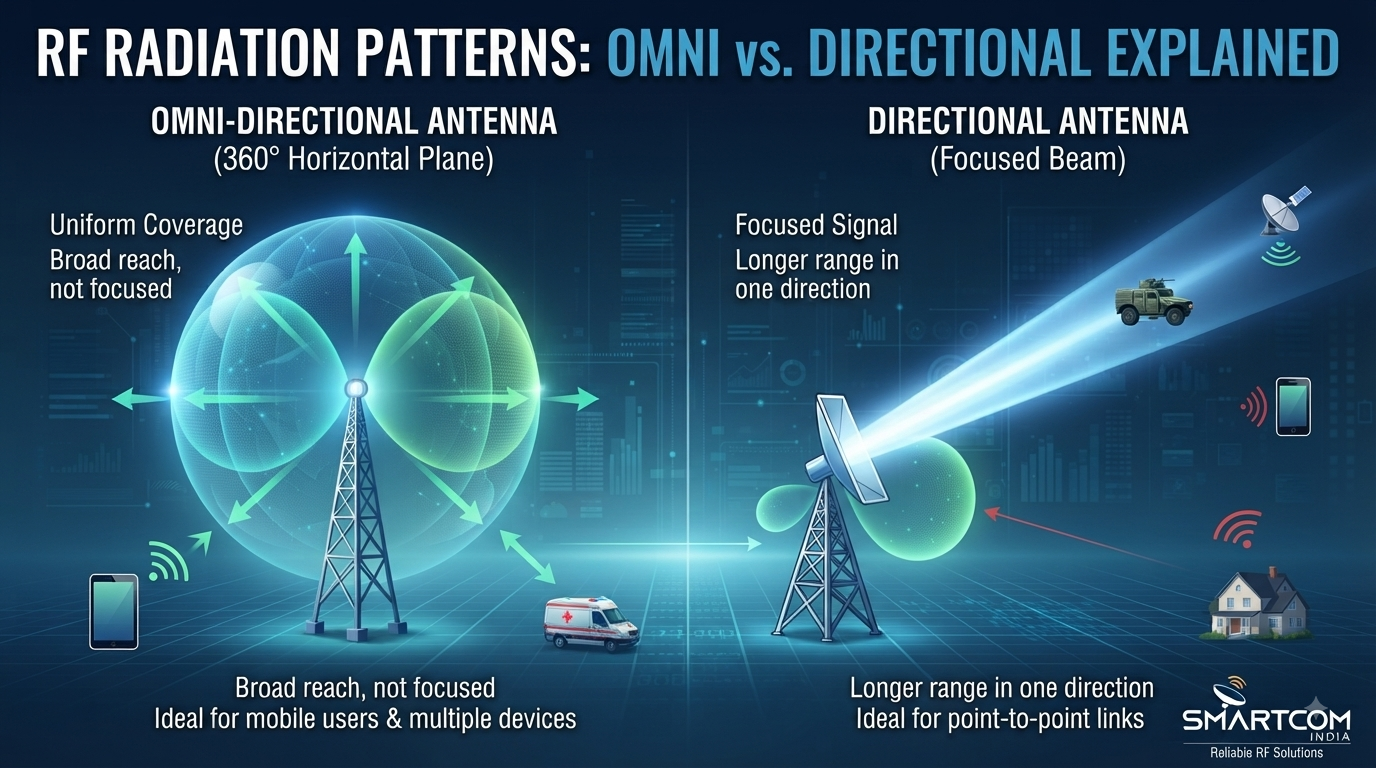
Feature | Omni Antenna | Directional Antenna |
Coverage | Broad horizontal coverage | Focused coverage |
Radiation | Around the antenna | Mainly in one direction |
Alignment | Usually minimal | Requires directional alignment |
Best suited for | Multiple directions | Specific target areas |
Common applications | Telecom, IoT, wireless networks | Point-to-point and focused links |
An omni antenna is generally preferred when broad coverage is required. A directional antenna is more suitable when RF energy needs to be concentrated toward a particular direction.
For focused RF communication, Smartcom also provides Yagi antennas and panel antennas.
How to Choose the Right Omni-Directional Antenna
Before selecting an omni antenna, consider:
- Operating frequency – Match the antenna to the required frequency band.
- Gain – Select gain according to the required coverage and system design.
- VSWR – Check impedance-matching performance.
- Polarisation – Match the antenna to the communication system.
- Installation environment – Consider indoor, outdoor and demanding environments.
- Mounting requirements – Check mounting space, connector type and dimensions.
- Mechanical requirements – Consider size, weight and construction.
The right antenna should be selected based on the complete RF system rather than frequency alone.
Looking for the Right Omni Antenna for Your Application?
Smartcom India offers standard and customised omni antennas for different frequency, gain, and coverage needs. Explore our omni antenna range for your RF application.
Why Choose Smartcom India?
Smartcom India provides standard and customised RF antenna solutions for different communication requirements. Its portfolio includes omni, Yagi, panel and monopole antennas.
Smartcom supports antenna design, development and manufacturing for telecom, defence, aerospace, space and industrial wireless applications.
Its omni antenna range covers multiple frequency bands, and custom frequency combinations and gains are available for specific project requirements. Smartcom’s engineering team also provides tailored antenna designs for systems up to 40 GHz.
For applications requiring a different antenna configuration, Smartcom also provides monopole antenna solutions for various RF communication requirements.
Conclusion
An omnidirectional antenna is a practical choice for wireless communication systems that require broad horizontal coverage rather than focused transmission in one direction. Its actual performance depends on frequency, gain, installation height, environment and the overall RF system.
Choosing the right antenna requires more than selecting a frequency. Coverage requirements, technical specifications, mounting conditions and application needs should also be considered.
Smartcom India provides standard and customised omni antenna solutions for telecom, defence, aerospace, space and other wireless communication applications. Contact Smartcom India to discuss your RF requirements and find an antenna solution suited to your application.
FAQ
What is an omnidirectional antenna?
An omnidirectional antenna is an RF antenna designed to transmit and receive signals across a broad 360-degree area in the horizontal plane.
Is an omni antenna suitable for long-distance communication?
It can be suitable for some long-distance systems. However, actual range depends on antenna gain, frequency, installation height, transmitter power, receiver sensitivity and environmental conditions.
What is the difference between an omni and panel antenna?
An omni antenna provides broad horizontal coverage, while a panel antenna focuses RF energy toward a specific direction. Panel antennas are useful when focused coverage is required.
What is the typical lifespan and weather resistance of an outdoor omni-directional antenna?
Outdoor models are built with ruggedized materials (such as fiberglass radomes and stainless steel mounts) and typically feature weather-sealing to withstand harsh winds, rain, and temperature fluctuations. Actual longevity depends on environmental conditions and proper installation.
Does mounting height significantly impact the coverage area of an omni antenna?
Yes. Raising the installation height generally increases the line-of-sight propagation and reduces obstruction loss from surrounding buildings or terrain, thereby expanding the effective coverage footprint.
How do I determine the correct gain (in dBi) for my omni-directional antenna?
The required gain depends on your coverage objective. Lower gain options provide a wider vertical beam for close-range, multi-directional access, whereas higher gain options compress the vertical beam to extend horizontal reach across broader areas.