
Panel Antenna vs. Omni Antenna: Which One Should You Choose?
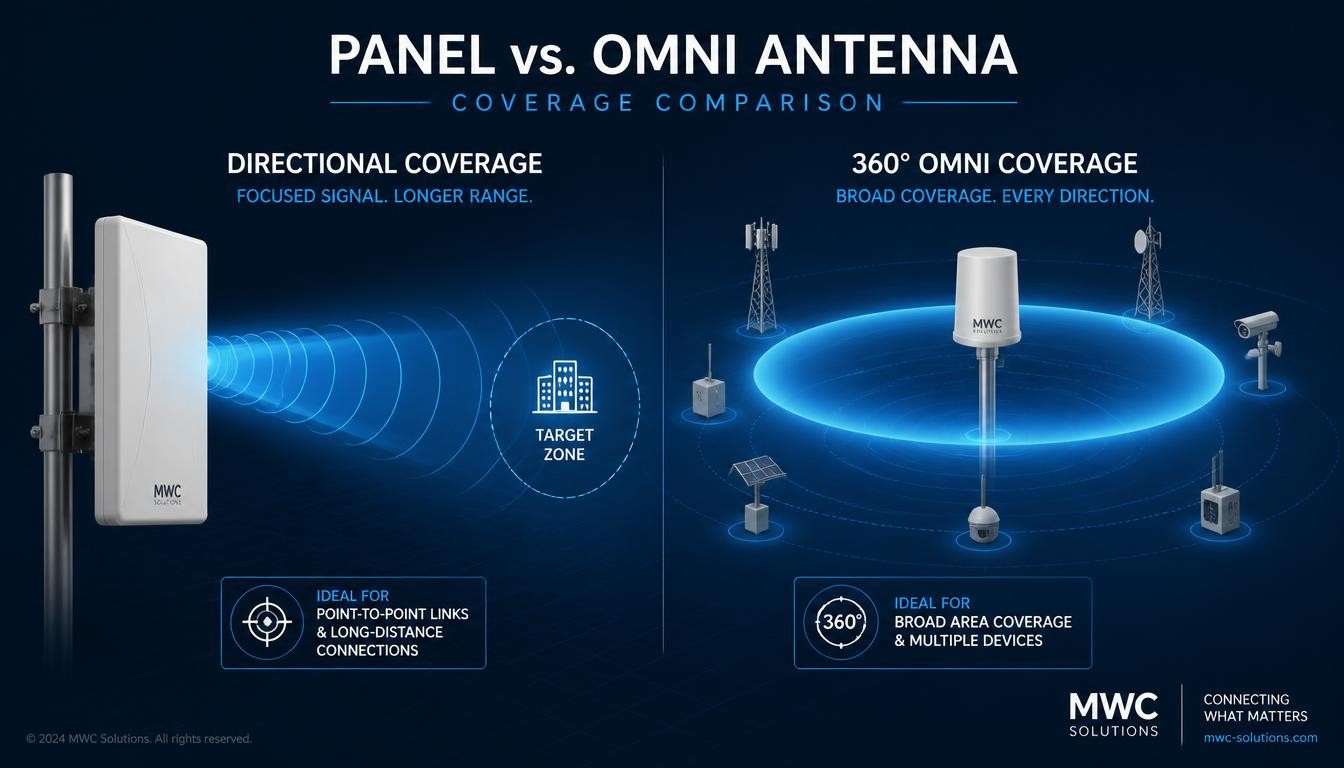
Setting up a reliable wireless network (whether for a large enterprise, a remote industrial site, or an office) depends heavily on selecting the right components. While routers and modems handle data processing, the antenna dictates how far, how strong, and in what direction your signal travels.
When choosing between a panel antenna vs omni antenna, the primary distinction lies in signal propagation, gain, and intended coverage area. Understanding these differences ensures your network delivers optimal throughput and minimal interference.
At Smartcom India, we provide RF antenna solutions designed for different coverage, frequency, and system requirements.
What Is an Omni Antenna?
An omni antenna (or omnidirectional antenna) radiates and receives radio frequency (RF) energy equally in a 360-degree horizontal plane. Think of its radiation pattern like an unshaded lightbulb illuminating an entire room evenly.
Because omni units spread energy across all directions, they typically offer lower antenna gain, usually ranging between 2 dBi and 9 dBi.
Key Characteristics
Coverage: 360-degree horizontal beamwidth.
Gain: Low to moderate gain level.
Setup: Requires no precise alignment or aiming.
Ideal Environments: Open spaces, central indoor offices, moving vehicles, and multi-directional client setups.
What Is a Panel Antenna?
A directional panel antenna is a flat, surface-mounted antenna that focuses RF energy in a specific direction, typically within a 60- to 120-degree arc. Instead of an unshaded bulb, think of a panel antenna like a focused spotlight beam.
By concentrating signal power toward a single vector, panel units achieve significantly higher directional antenna coverage and range while rejecting off-axis interference.
Key Characteristics
Coverage: Focused directional beamwidth (60° to 120°).
Gain: High gain, typically 7 dBi to 14+ dBi.
Setup: Requires precise line-of-sight alignment toward the target signal source.
Ideal Environments: Point-to-point links, long corridors, outer building walls, and cellular signal booster installations.
Not sure which coverage pattern fits your infrastructure?
Compare high-gain directional panels and broad 360° omni units in our complete RF Antenna Product Catalog to find engineered solutions built for high-density environments.
Panel Antenna vs Omni Antenna: Key Comparisons
Feature | Omni Antenna | Panel Antenna |
Signal Pattern | 360° Horizontal Circle | Focused Forward Arc (60°–120°) |
Gain Level | Lower (2–9 dBi) | Higher (7–14+ dBi) |
Coverage Distance | Shorter, wider reach | Longer, targeted reach |
Interference Resistance | Low (picks up noise from all sides) | High (ignores side and rear noise) |
Alignment Needed? | No alignment required | Manual aiming required |
How to Choose the Right Antenna for Your Setup
Selecting the ideal equipment comes down to evaluating your physical environment, signal sources, and user mobility:
- Choose an Omni Antenna If:
- Your users or devices move around in all directions relative to the signal source.
- You are setting up general indoor Wi-Fi coverage in a square, open floor plan.
- You need signal coverage for mobile applications like transport fleets or marine vessels.
- Choose a Panel Antenna If:
- You need to connect to a single, distant cellular tower in fringe or rural areas.
- You are linking network signals along long hallways, tunnels, or narrow spaces.
- You want to wall-mount an antenna indoors or outdoors to direct coverage inward across a specific zone without wasting signal behind the wall.
High-performance deployments often leverage both types. For instance, commercial setups designed by engineering specialists frequently integrate directional panel units on building exteriors for long-range backhaul, paired with internal omni units for seamless room-level connectivity.
Planning a complex RF deployment or struggling with signal dead zones?
Request a Wireless Site Audit with Smartcom‘s RF engineers to get an optimized coverage blueprint tailored to your facility.
Why Choose Smartcom for Enterprise Wireless Solutions?
Deploying enterprise network infrastructure requires more than off-the-shelf hardware. It demands precise RF planning, optimal gain selection, and robust build quality.
Smartcom Design & Solutions provides high-reliability communication solutions engineered for demanding enterprise, industrial, and cellular applications. By combining expert site evaluations with industry-grade hardware, Smartcom ensures your RF deployment maximizes signal integrity, reduces dead zones, and supports scalable growth.
Looking for the right antenna for your RF system?
Conclusion
Choosing between a panel antenna vs omni antenna ultimately depends on whether your priority is broad 360-degree coverage or long-distance, directional performance. Matching your antenna pattern to your physical environment ensures lower latency, higher signal quality, and seamless operational reliability.
FAQ
How does weather or outdoor placement impact these antennas?
Outdoor panel and omni antennas both require weatherproofing, such as IP67-rated enclosures, to withstand wind and rain. However, high-wind areas favour low-profile panel antennas because their flat, wall-mounted designs create less wind resistance than tall omni poles.
Can mounting a panel antenna on a metal building cause signal reflections?
Yes, mounting a panel antenna directly against a flat metal wall can cause RF reflections and alter its radiation pattern. Installers use standoff brackets to create distance between the wall and the antenna backplane to maintain signal purity.
Do panel and omni antennas use different types of coaxial cables?
Both antenna types generally use standard 50-ohm coaxial cables, such as LMR-200 or LMR-400. However, high-gain panel antennas used over long cable runs require thicker, low-loss cabling to prevent signal loss before it reaches the receiver.
Both antenna types generally use standard 50-ohm coaxial cables, such as LMR-200 or LMR-400. However, high-gain panel antennas used over long cable runs require thicker, low-loss cabling to prevent signal loss before it reaches the receiver.
Horizontal beamwidth refers to the signal's left-to-right spread, while vertical beamwidth measures its top-to-bottom height. Omni antennas have a narrow vertical beamwidth, meaning they spread signal wide horizontally but poorly between different building floors.