
How to Choose the Right RF Antenna for Telecom, Defence & IoT Projects
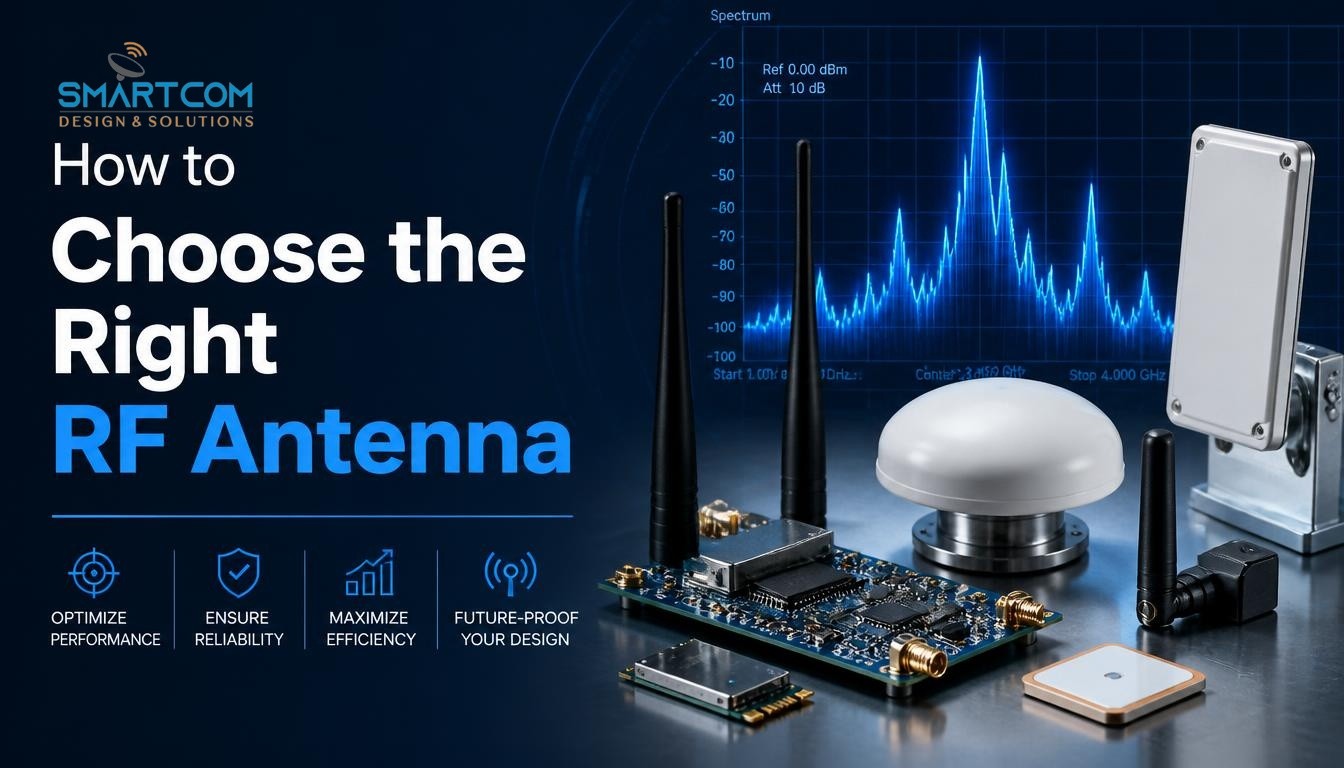
Selecting a reliable engineering partner is essential for industries that depend on robust wireless connectivity. While choosing the right RF antenna manufacturer is important, the hardware must also align precisely with your application’s frequency, coverage, gain, environment, and mechanical requirements. An antenna suitable for commercial telecom may not perform in military or compact IoT deployments.
Because telecom networks, defence systems, and IoT nodes operate under vastly different parameters, your technical evaluation and selection process should always start with system requirements rather than choosing a component based on catalogue size or maximum gain. For teams navigating these complex multi-band architectures, working with an experienced domestic provider like Smartcom India ensures standard or custom-engineered solutions align precisely with your site’s physical and electrical specifications from day one.
Step 1: Map Out the Operating Frequency Band and Bandwidth
Operating frequency is the foundation of RF engineering and component selection.
- The Spectrum Landscape: RF systems operate across VHF, UHF, cellular, L-band, S-band, C-band, X-band, Ku-band, and specialised frequencies.
- Resonance and Tuning: The antenna must be engineered to resonate effectively within the required operational band. Even minor frequency drift outside design parameters can cause significant insertion loss, degrade signal-to-noise ratio, and reduce receiver sensitivity.
- Narrowband vs. Wideband Requirements: Determine if your system needs narrowband filtering or wideband frequency-hopping, which is critical for tactical defence and advanced telecom applications.
Step 2: Define the Required Radiation Pattern (Omni vs. Directional)
Before looking at mechanical form factors, define your spatial coverage goals. Do you need broad coverage or targeted point-to-point communication?
Omni-Directional Antennas
Omni-directional antennas are ideal when mobile units, base stations, or IoT nodes are distributed in multiple directions, providing 360-degree horizontal coverage.
Panel Antennas
Panel and directional antennas focus RF energy toward a specific sector or zone, maximising signal strength in one direction.
Yagi Antennas
Yagi Antennas is a highly directional setups used when you require focused, long-distance point-to-point communication, telemetry reception, or specialised directional monitoring.
Step 3: Evaluate Antenna Gain vs. Geometric Coverage Constraints
Gain measures how well an antenna focuses RF energy in a specific direction compared to an isotropic radiator. However, higher gain is not always the best choice for every project.
- The Beamwidth Trade-off: Higher gain compresses the vertical beamwidth, producing a narrower, more focused horizontal or vertical radiation pattern.
- Application Fit: While a high-gain panel antenna is effective for long-distance fixed links but may create coverage gaps below the installation site in dense urban or mobile networks. Select gain based on your coverage geometry.
Step 4: Check VSWR and Impedance Matching Parameters
Voltage Standing Wave Ratio (VSWR) measures how efficiently RF power is transmitted from the transmission line to the antenna.
- Minimising Reflected Power: An optimal VSWR (ideally maintained under 1.5:1 for high-performance deployments) helps minimise reflected power, protecting your active RF front-end components, power amplifiers, and transceiver circuitry from dangerous thermal overloads.
- Bandwidth Sweeps: Always review the VSWR curve across your entire operational bandwidth rather than relying on a single best-case datasheet number at a fixed frequency point.
Step 5: Account for Environmental and Mechanical Realities
The deployment environment determines the structural, material, and thermal requirements for your hardware:
- Outdoor Telecom Infrastructure: Demands heavy-duty weather-resistant radomes, UV stabilisation, and high wind-load tolerance to withstand harsh elements over years of continuous outdoor operation.
- Defence and Aerospace Systems: Requires ruggedised construction to withstand severe mechanical shocks, high-frequency vibrations, salt-fog corrosion, and extreme thermal ranges.
- IoT and Smart Devices: Prioritises compact footprints, low power consumption profiles, and seamless internal or external enclosure integration for smart meters and industrial sensors.
Step 6: Match Polarisation Requirements
Polarisation is the orientation of the electric field radiated by the antenna.
- Configuration Types: Systems typically rely on vertical or horizontal polarisation, while advanced radar, satellite, and high-capacity wireless links utilise dual-polarised or circular setups.
- Preventing Mismatch Losses: Maintaining matched polarisation between the transmitter and receiver is essential to prevent severe signal polarisation mismatch losses that can cripple link margins.
Step 7: Explore Custom RF Antenna Design Solutions
Standard catalogue products suit generic applications, but complex projects often require specialised engineering. When standard options are insufficient, partnering with an established RF antenna manufacturer in Bangalore enables you to develop custom solutions for unique frequency bands, radiation patterns, and mechanical requirements.
Core RF Requirements by Industry Application
Telecom Projects
Telecom deployments prioritise reliable carrier-grade coverage, stable multi-band frequency response, controlled gain patterns, and robust structural durability to minimise site maintenance downtime across cellular and wireless infrastructure.
Defence Projects
Defence and aerospace applications operate under demanding physical and electronic constraints, requiring strict compliance with environmental durability, wide frequency coverage, high power handling, and secure system integration.
IoT & Industrial Projects
Internet of Things implementations centre around compact device footprints, optimised power efficiency, reliable multi-technology connectivity, and streamlined physical integration for smart grids and remote asset tracking.
Why Choose Smartcom India?
Working with an experienced domestic engineering and manufacturing provider ensures reliable wireless infrastructure. Smartcom India is a trusted industry leader because of:
- End-to-End In-House Capabilities: Covering concept design, rigorous electromagnetic simulation, rapid prototyping, and scalable volume production under strict quality frameworks.
- Make in India Commitment: Leveraging locally sourced, high-grade materials to streamline production timelines while maintaining uncompromising international performance standards.
- Custom Engineering Expertise: Providing tailored configurations for complex defence, aerospace, telecom, and IoT deployments that standard off-the-shelf catalogue hardware cannot satisfy.
Ready to optimise your wireless system architecture?
Conclusion
Selecting the right RF antenna requires more than reviewing datasheets. Evaluate frequency, durability, polarisation, and system geometry. Align your design with performance criteria and partner with a capable manufacturer to ensure stable, long-term operation across telecom, defence, and IoT applications.
FAQ
How do I choose the right RF antenna?
Start by identifying your operating frequency, bandwidth, radiation pattern, gain, installation environment, and physical constraints. Align these with your system architecture before reviewing hardware options.
Is a higher-gain RF antenna always better?
No. Higher gain narrows the beam width and can limit coverage. The correct gain depends on your coverage geometry and whether you need broad or focused connectivity.
Why choose a custom RF antenna manufacturer?
Custom engineering is necessary when catalogue specifications cannot meet your exact frequency range, physical space limitations, high-power handling, or environmental protection standards.
How do environmental factors like extreme temperatures and humidity influence RF antenna selection in industrial?
Harsh field environments introduce material expansion, moisture ingress, and thermal stress that degrade standard commercial components. For defence and heavy industrial deployments, antennas require specialised radome materials, hermetic sealing, and ruggedised mechanical mounts to prevent impedance mismatch and structural failure over extended life cycles.
What role does computer-aided electromagnetic simulation play during custom RF antenna development?
Advanced simulation software models radiation patterns, current distributions, and return loss parameters before physical prototyping begins. This engineering phase eliminates guesswork, optimises VSWR across custom frequency bands, and significantly shortens the development timeline for specialised telecom or IoT hardware.
Why is local manufacturing a strategic advantage when procuring custom RF antennas in India?
Sourcing custom hardware from a domestic manufacturer like Smartcom India streamlines logistics, reduces lead times, and enables direct collaboration with engineers. Local manufacturing also ensures compliance with regional certifications and quality standards.