
Yagi Antenna: How It Works, Key Features, and Applications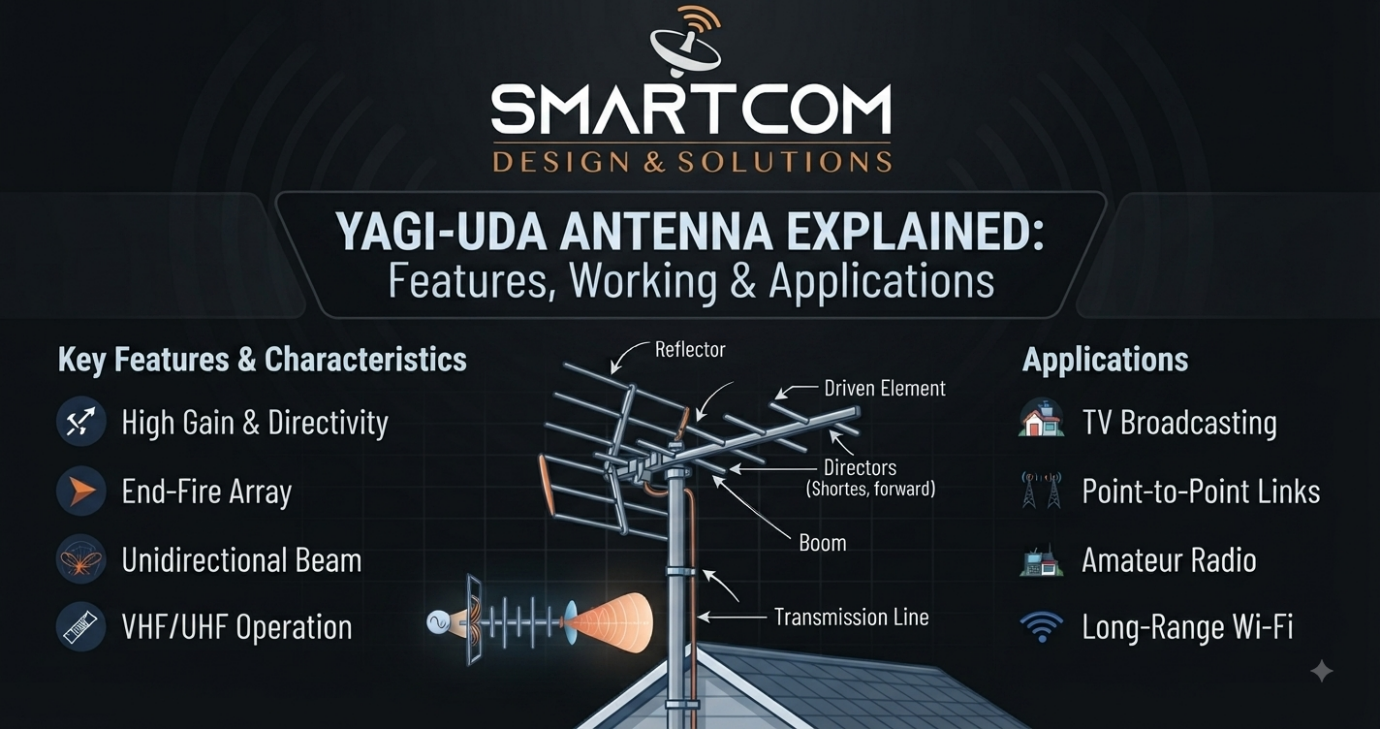
A Yagi antenna, also known as a Yagi-Uda antenna, is a type of antenna designed to transmit or receive radio signals primarily in a single direction.
The Yagi antenna consists of multiple elements aligned along a boom, resulting in directional radiation and significant gain for communication and reception systems. Smartcom manufactures Yagi antennas for various frequency ranges, including VHF, UHF, and other RF applications.
For reliable Yagi antennas for your RF application, please contact our team.
What Is a Yagi-Uda Antenna?
A Yagi-Uda antenna normally consists of:
- A driven element
- A reflector
- One or more directors
- A supporting boom
The driven element connects to the RF feed, while the reflector and directors shape the electromagnetic field to form a directional radiation pattern.
How Does a Yagi Antenna Work? 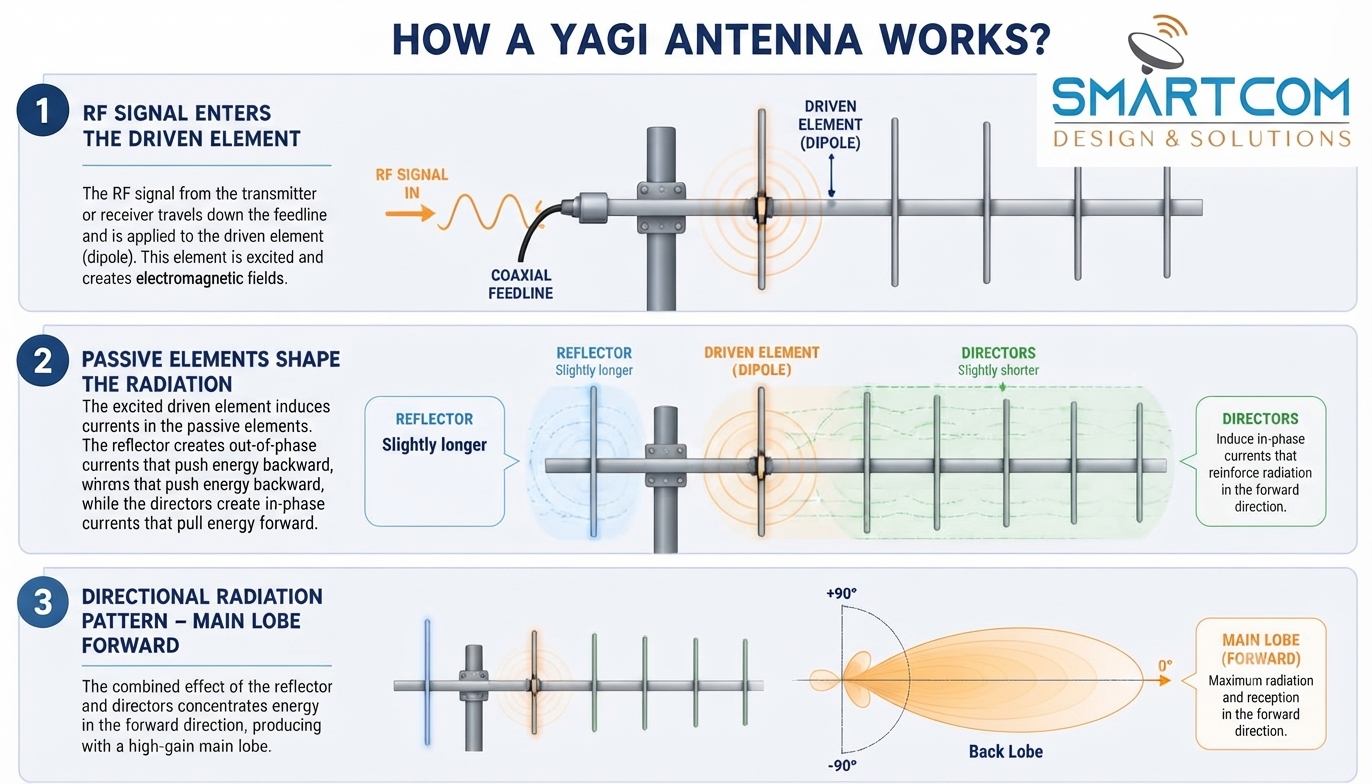
The working principle can be explained in three simple stages.
RF Signal Enters the Driven Element
During transmission, the RF signal is supplied to the driven element.
Passive Elements Shape the Radiation
The reflector and directors interact with the electromagnetic field, with their lengths and spacing determined by the operating frequency.
Energy Is Concentrated in One Direction
The element arrangement produces a directional radiation pattern, focusing RF energy toward the intended direction.
During reception, the process is reversed: the antenna collects signals from the preferred direction and delivers the electrical signal to the RF system.
Main Features of a Yagi Antenna
Directional Radiation Pattern
The primary feature of a Yagi antenna is its directionality, focusing RF energy rather than providing equal coverage in all directions.
Useful Gain
Yagi antennas provide directional gain, which depends on their design and the number of elements.
Frequency-Specific Design
Element dimensions and spacing are determined by frequency, so each Yagi antenna is designed for a specific operating band.
Compact Mechanical Structure
Yagi antennas use a simple element-and-boom structure, making them suitable for a range of outdoor and communication installations.
Yagi Antenna vs Omni Antenna
A Yagi antenna is directional, whereas an omni antenna provides broad horizontal coverage.
A Yagi antenna is preferred when the communication target is defined, and focused signal coverage is needed. An omni antenna is suitable when devices are distributed around the antenna.
Choose the appropriate antenna for your RF application with Smartcom’s antenna solutions.
Applications of Yagi Antennas
Yagi antennas can be used in:
- Telecom communication
- RF monitoring
- Broadcast systems
- Industrial wireless communication
- Defence communication
- Point-to-point RF links
- Signal reception systems
- Interference-sensitive environments
Suitability depends on factors such as frequency, gain, polarisation, environment, and system requirements.
How to Select a Yagi Antenna
Consider these factors before choosing a Yagi antenna:
Operating Frequency
First, identify the frequency band required by the RF system.
Gain
Determine the required level of directional performance for your application.
Number of Elements
Element configuration affects both the antenna’s electrical performance and physical size.
Polarisation
Select horizontal or vertical polarisation as required for your system.
Mounting Requirements
Ensure the antenna is compatible with the available mounting structure and installation conditions.
Smartcom offers customised Yagi configurations, including element count, polarisation, and mounting options.
Explore our complete range of high-performance RF solutions.
Why Choose Smartcom India
RF projects often require specific frequency, gain, mechanical dimensions, and mounting options. A custom Yagi antenna can be tailored to your requirements, rather than forcing your system to adapt to a standard product.
Reach out to Smartcom India to find the ideal Yagi antenna or to develop a custom RF solution for your needs.
Conclusion
A Yagi antenna is effective when your RF system requires focused transmission or reception. However, select the antenna based on the entire communication link, not solely on gain. Smartcom’s engineering team provides customised frequency combinations and antenna designs for applications with specific RF requirements.
FAQ
What is a Yagi antenna used for?
A Yagi antenna is used to send and receive radio signals in a specific direction, making it ideal for applications that require concentrated coverage and minimal signal loss.
Why is it called a Yagi-Uda antenna?
The Yagi-Uda antenna is named after its inventors, Hidetsugu Yagi and Shintaro Uda.
Is a Yagi antenna directional?
Yes. The Yagi antenna is notable for its strong directionality, enabling it to target signals with high precision.
Is a Yagi antenna suitable for long-distance communication?
A Yagi antenna is suitable for long-distance radio frequency links when frequency selection, gain, installation parameters, and link budget are properly configured.
Can Yagi antennas be customised?
Yes. Yagi antenna designs can be customised to meet specific requirements for frequency, gain, element configuration, polarisation, and mounting.