
Monopole Antenna: Working Principle, Benefits & Industrial Applications
In today’s wireless world, getting a strong signal in all directions from a small device is a big challenge. From cell phone towers to radio-controlled cars and smart meters, engineers rely heavily on a smart design called the monopole antenna.
RF engineering teams, including the experts at Smartcom, choose this design repeatedly because it provides an efficient solution for coverage challenges. If you want to understand the fundamentals of RF antennas before exploring monopole designs, read our guide on what an RF antenna is and how it works.
What Is a Monopole Antenna?
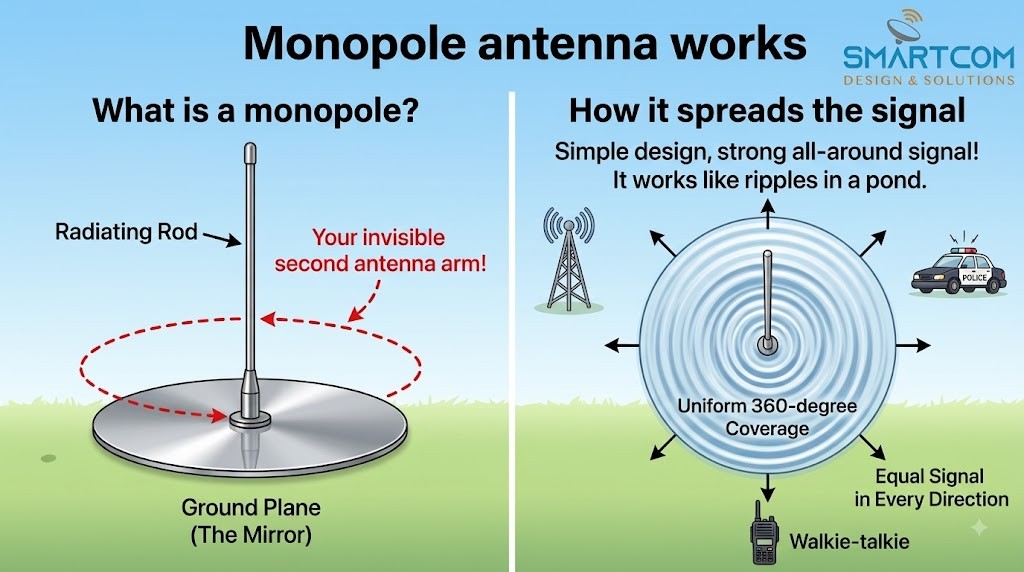
A monopole antenna is a single metal rod or wire standing upright on a flat metal sheet called a ground plane. In practice, a ground plane monopole antenna can use a solid metal sheet, a car roof, or even a set of thin metal rods (called radials) spread out flat; as long as it’s conductive and wide enough, it does the job.
To understand it best, compare it to a basic two-sided radio antenna (a dipole antenna):
Dipole Antenna: Has two equal metal arms spreading out in opposite directions.
Monopole Antenna: Has one metal rod sticking up. The metal sheet underneath acts like a “mirror” that creates a virtual second arm. Because the ground plane acts like a mirror, a monopole antenna only needs to be half the height of a regular dipole antenna.
What Is a Quarter-Wave Monopole Antenna?
The most common type you’ll run into is the quarter-wave monopole antenna. The name simply describes its length: the metal rod is cut to one-quarter of the wavelength of the radio signal it’s designed to send or receive.
Why a quarter and not a full wave?
Because of the ground plane mirror effect covered above, the reflection supplies the “missing” other quarter, so a quarter-wave rod behaves electrically like a half-wave dipole. That’s the whole trick that makes monopole antennas so compact. Cutting the rod to this exact length is also what keeps the antenna tuned to its target frequency and easy to match to standard 50-ohm feed lines; a shorter or longer rod throws off performance.
How Does a Monopole Antenna Work?
The magic behind a monopole antenna comes down to two simple ideas: mirrors and 360-degree coverage.
1. The Mirror Effect
When electricity runs up the single metal rod, it creates radio waves. The flat metal sheet at the bottom reflects these waves upward. This reflection makes the antenna “think” there is a second metal rod underneath it, creating a full signal without needing the extra physical space.
2. Radiation Pattern: Equal Signal in All Directions
A monopole antenna sends out signals evenly all around itself in a full 360° circle. If you look at it from above, the radio waves spread out in every direction equally, just like ripples in a pond when you drop a pebble. This doughnut-shaped, all-around monopole antenna radiation pattern is what makes the antenna omnidirectional: strong horizontally in every direction, weaker straight up and down along the rod itself.
Key Advantages of Monopole Antennas
Why do engineers pick monopole antennas over other designs?
Small and Compact: Since it only uses one rod instead of two, it fits easily on car roofs, small walkie-talkies, and small circuit boards.
All-Around Coverage: You don’t need to point a monopole antenna at a specific target. It picks up signals from any direction.
Tough and Durable: A single straight rod is easy to build, hard to break, and can survive strong winds and weather.
Monopole Antenna Applications: Where Are They Used?
Monopole antennas are all around us in everyday life and industrial setups:
- Cell Towers & Mobile Networks: They help send signals evenly to phones travelling in any direction around a tower.
- Cars & Public Safety: The metal roof of a police car or fire truck acts as the ground plane for a small whip antenna on top, helping officers stay in touch.
- Smart Factories & IoT: Devices like smart electric meters and factory sensors use small monopole antennas to send data automatically.
- Walkie-Talkies & Portable Radios: Handheld radios use flexible rubber monopole antennas to keep the device light and easy to carry.
Why Choose Smartcom India
Whether you need high-volume supply for smart meters, ruggedised whip antennas for tactical vehicles, or custom PCB monopole integration, Smartcom delivers precision-engineered RF solutions.
- Broad Frequency Support (VHF, UHF, GSM, 5G, and IoT)
- Custom Ground Plane & Impedance Tuning
- Made in India Engineering & Production
Explore Smartcom’s high-performance RF antennas, engineered for precision, reliability, and demanding communication applications.
Conclusion
Monopole antennas offer a simple, compact way to send and receive radio signals in every direction. By using a metal ground plane as an invisible mirror, they save space while keeping communications strong.
FAQ
What is a monopole antenna, in simple terms?
It's a single metal rod mounted on a flat conductive surface (the ground plane). The ground plane mirrors the rod electrically, so the antenna behaves like a full dipole while using only half the metal.
Monopole antenna vs dipole antenna, which should I use?
Pick a monopole when you need a compact, single-point feed and already have a metal chassis or panel to act as the ground plane, such as a car roof or circuit board. Pick a dipole when there's no suitable ground plane, or you need a self-contained antenna that doesn't depend on a mounting surface.
What is a quarter-wave monopole antenna used for?
It's the standard design for cell towers, walkie-talkies, car radios, and IoT devices, anywhere engineers want strong 360-degree coverage from a rod that's only a quarter of a wavelength long.
Does the size of the ground plane matter?
Yes. A ground plane monopole antenna needs a conductive surface at least roughly a quarter-wavelength wide in every direction to reflect signals cleanly. A too-small or non-conductive mounting surface distorts the radiation pattern and weakens the signal.