
RF Diplexer Vs Duplexer: Key Differences and Applications
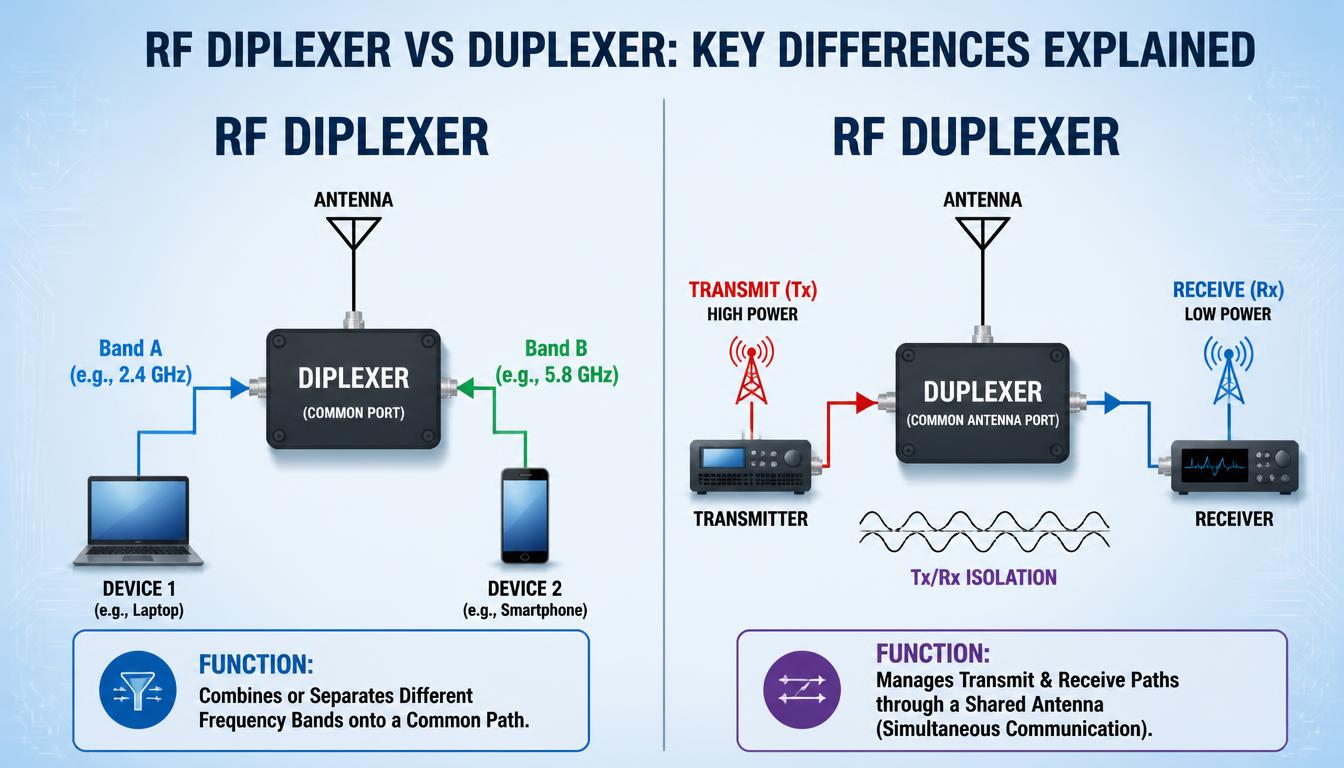
RF diplexers and duplexers manage signals through shared connections in radio-frequency systems. Although their names are similar, they perform different functions. Understanding the RF diplexer vs duplexer distinction helps engineers select a component that matches their system architecture.
The main difference concerns what the component separates. A diplexer typically manages two different frequency bands. A duplexer typically lets a transmitter and receiver share an antenna while providing the isolation needed between the transmit and receive paths.
What Is an RF Diplexer?
An RF diplexer is a frequency-selective component that combines two frequency bands onto a common path or separates them into two paths.
A typical diplexer has one common port and two band-specific ports. Each branch is designed for a particular frequency range.
For example, a wireless system may need to route two different frequency bands through one antenna feed. A diplexer can provide the required frequency-selective paths when its passbands, isolation and power ratings match the application.
What Is an RF Duplexer?
An RF duplexer manages transmit and receive paths, often allowing a transmitter and receiver to share an antenna. In many systems, the transmitter and receiver operate at different frequencies, and the duplexer provides frequency-selective routing and isolation between them.
The design must limit transmitter energy reaching a sensitive receiver while allowing the intended signals to pass through their respective paths.
Duplexers are commonly associated with radio communication systems that transmit and receive through a shared antenna.
RF Diplexer Vs Duplexer: Main Differences
Feature | RF diplexer | RF duplexer |
Main purpose | Combines or separates two frequency bands | Separates or manages transmit and receive paths |
Typical use | Two-band signal routing | Shared-antenna transmit/receive operation |
Frequency plan | Two specified bands | Transmit and receive bands or channels |
Key considerations | Passbands, insertion loss and isolation | Transmit-to-receive isolation, passbands and receiver protection |
System requirement | Two frequency-selective paths | Transmit and receive paths with suitable isolation |
These are functional distinctions rather than absolute rules for every design. Actual terminology and port arrangements can vary by application and manufacturer.
How Does a Diplexer Work?
A diplexer uses frequency-selective branches to direct signals based on frequency.
Each branch passes its intended frequency range while attenuating signals outside that range. The branches meet at a common port, allowing two bands to share a path.
The design must account for insertion loss, isolation, impedance matching, power handling and the frequency relationship between the branches.
How Does a Duplexer Work?
A duplexer separates the transmit and receive paths of a radio system. In a frequency-division arrangement, the transmitter and receiver operate in separate frequency bands.
The duplexer passes the required signals while reducing unwanted coupling between the transmitter and receiver. This is important because strong transmit energy can interfere with or overload a sensitive receiver.
Required isolation depends on transmitter power, receiver sensitivity, frequency separation and the complete radio architecture.
Can a Diplexer and Duplexer Be Interchangeable?
Not automatically. Both may use frequency-selective filtering, but the required functions and performance targets can differ.
An engineer should not select a component solely because it has a similar number of ports or operates in a related frequency range. The component must meet the systems transmit, receive, isolation and power-handling requirements.
Which Specifications Should Engineers Compare?
Operating Frequency
Identify the frequencies or bands that must pass through each path.
Isolation
Check the required isolation between the relevant ports. For duplexer applications, transmit-to-receive isolation is especially important.
Insertion Loss
Evaluate the loss through each intended path because excessive loss can reduce transmitted power or weaken received signals.
VSWR and Return Loss
Check impedance matching at the operating frequencies to limit unwanted reflections.
Power Handling
Confirm that the component can withstand the expected transmitter power and operating conditions.
Physical and Interface Requirements
Check connectors, impedance, mounting dimensions and environmental limits.
Which Component Does Your RF System Need?
Consider a diplexer when the primary requirement is to combine or separate two frequency bands on a common path.
Consider a duplexer when the system needs to manage transmit and receive paths through a shared antenna and requires the corresponding isolation.
For complex systems, the correct choice depends on the frequency plan, radio architecture and component specifications. Review the complete signal path rather than selecting a component based on its name alone.
Explore RF Diplexer Options with Smartcom India
Smartcom India lists RF diplexers and triplexers for RF system applications. To evaluate a suitable configuration, review the published frequency bands, insertion loss, isolation, VSWR and power specifications.
Conclusion
Diplexers and duplexers serve related but distinct purposes in RF systems. A diplexer manages two frequency bands, while a duplexer commonly manages transmit and receive paths.
Selecting the right component requires understanding the signal architecture and verifying that its specifications meet the system requirements.
FAQ
What is the main difference between a diplexer and a duplexer?
A diplexer separates or combines two distinct frequencies. A duplexer, by contrast, isolates the transmit and receive signal paths at different frequencies within the same band, enabling simultaneous two-way communication over a single antenna.
Can a diplexer be used as a duplexer?
Generally, no. A standard diplexer lacks the high port-to-port isolation and narrow bandpass selectivity required to protect a sensitive receiver from high transmit power. A diplexer can act as a duplexer only if its attenuation, isolation, power handling, and frequency spacing meet the transceiver system's full operational requirements.
Does a duplexer always use different transmit and receive frequencies?
In Frequency Division Duplexing systems, yes, the transmitter and receiver operate on separate, dedicated frequencies to avoid mutual interference. However, in Time Division Duplexing systems, transmit and receive share the same frequency, using rapid time-domain switching instead of a frequency-selective duplexer.
Why is isolation so important in a duplexer?
High isolation prevents high-power transmit signals from leaking into the receive path. Without adequate isolation, transmitter energy can overload or damage the receiver, degrade signal clarity, and introduce unnecessary noise into the RF chain.
How should engineers choose between a diplexer and a duplexer?
Selection depends on your system architecture and RF requirements:
• Choose a diplexer when you need to combine or split two different frequency bands onto a shared transmission path.
• Choose a duplexer when your system requires simultaneous transmission and reception over a single antenna within the same frequency band.
• Key Specifications to Evaluate: Always review frequency allocation, required port isolation, maximum insertion loss, return loss power handling, and mechanical connector constraints.