
Overview of RF Filters: Low Pass, High Pass, and Band Pass Types
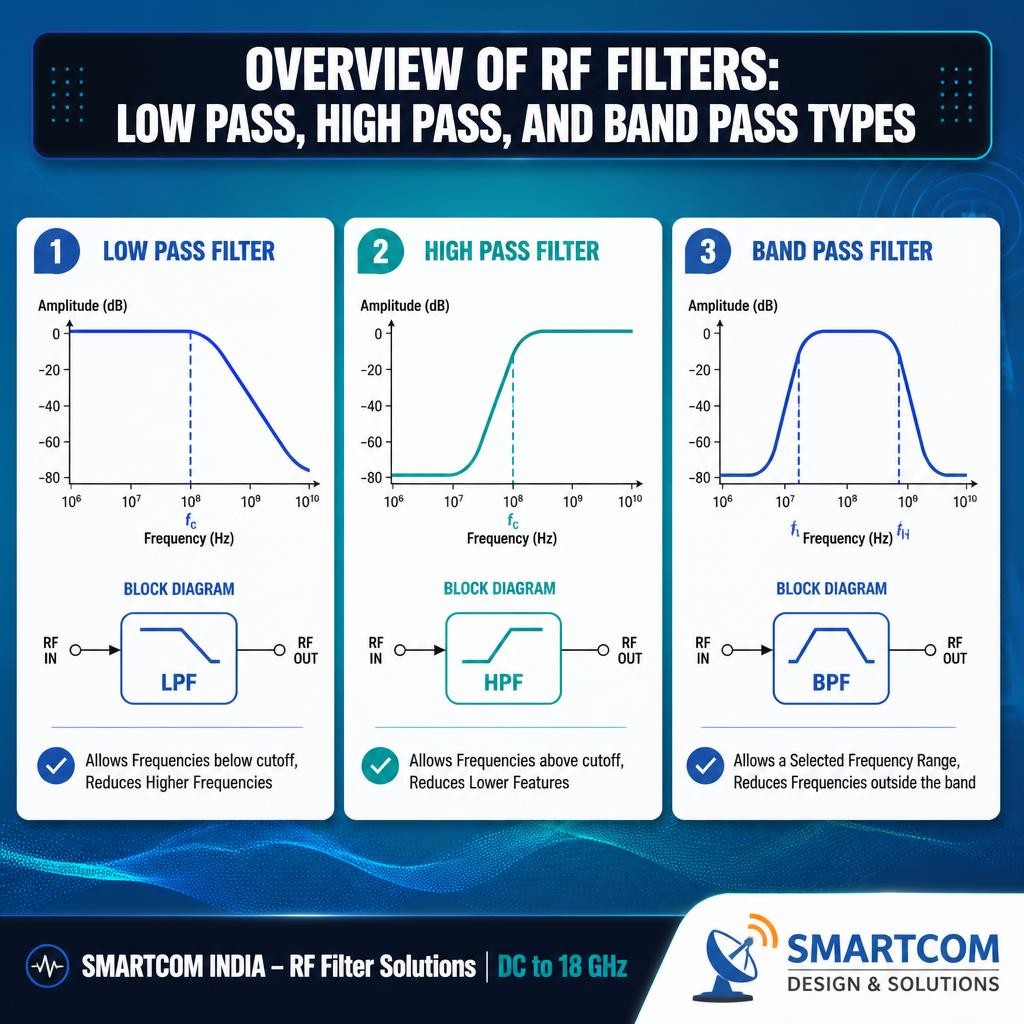
An RF filter is a passive component that permits selected radio frequencies while attenuating unwanted ones. RF filters are essential in communication and wireless systems for managing signals entering or exiting an RF circuit.
In practical RF systems, multiple signals, harmonics, and interference often occur simultaneously. An appropriate filter isolates desired frequencies from unwanted signals, improving overall system performance.
Engineers select low-pass, high-pass, or band-pass RF filters based on application needs. Each filter type offers a distinct frequency response suited to specific system requirements.
Smartcom India provides RF filter solutions covering DC to 18 GHz, including low-pass, high-pass, and band-pass designs.
What Does an RF Filter Do?
The main purpose of an RF filter is to select frequencies.
When multiple radio signals travel through the same RF system, but only a specific frequency range is needed, an RF filter attenuates signals outside the required range and lets the desired frequencies pass.
RF filters can help with:
- Reducing unwanted signals
- Suppressing harmonics
- Improving receiver performance
- Protecting RF front-end components
- Managing specific frequency bands
- Controlling interference within an RF system
Filter selection depends on factors such as frequency range, bandwidth, rejection, insertion loss, and power requirements.
What Is a Low-Pass RF Filter?
A low-pass RF filter allows frequencies below a defined cut-off frequency to pass while reducing frequencies above the cut-off.
For example, if an RF system needs to pass signals below a specific frequency, a low-pass filter can reduce higher-frequency components that are not required.
Low-pass RF filters are frequently used in transmitter output stages, harmonic suppression, and other scenarios where higher-frequency signals must be attenuated.
The performance of a low-pass RF filter depends on its cut-off frequency, insertion loss, rejection and power-handling capability.
What Is a High-Pass RF Filter?
A high-pass RF filter operates oppositely to a low-pass filter, allowing frequencies above a defined cut-off to pass while attenuating lower-frequency signals.
High-pass RF filters are useful for reducing unwanted low-frequency signals or interference in an RF system.
They can also remove DC components from specific RF signal paths.
The required cut-off frequency depends on the operating frequency and application. Selecting the appropriate high-pass filter requires identifying which frequencies must pass and which should be rejected.
What Is a Band Pass Filter?
A band pass filter allows a selected range of frequencies to pass while reducing frequencies below and above that range.
For example, in an RF communication system operating within a specific frequency band, a band pass filter limits unwanted signals outside the designated range.
Band-pass filters are commonly used in transmitters, receivers, and other frequency-selective RF subsystems.
Key specifications include centre frequency, bandwidth, insertion loss, and rejection.
Low Pass vs High Pass vs Band Pass
Filter Type | Allows | Reduces |
Low Pass | Frequencies below the cut-off | Higher frequencies |
High Pass | Frequencies above the cut-off | Lower frequencies |
Band Pass | A selected frequency range | Frequencies outside the band |
The right RF frequency filter depends on the application requirements. Consider frequency range, rejection, insertion loss, power handling, and system configuration before selecting a filter.
Important RF Filter Specifications
Choosing an RF filter involves more than selecting the filter type. Several technical specifications affect filter performance.
Cut-off or Centre Frequency
The cut-off frequency is important for low pass and high pass filters. For a band-pass filter, the centre frequency identifies the middle of the intended operating range.
Pass Band
The pass band is the frequency range that the filter is designed to allow through with its specified performance.
Insertion Loss
Insertion loss indicates the reduction in signal power caused by the filter within its intended operating range. Lower insertion loss is generally preferred when maintaining signal strength is important.
Rejection
Rejection indicates how strongly the filter reduces unwanted frequencies at specified frequencies. The required rejection level depends on the application and interference environment.
VSWR
VSWR, or Voltage Standing Wave Ratio, indicates how well the filter matches the RF system. A suitable match can help reduce signal reflections.
Power Handling
The filter must handle the RF power used by the application. Power requirements are particularly important in transmitter and high-power RF systems.
Learn more about RF connectors for high-frequency applications.
Why Are RF Filters Important in Communication Systems?
Modern wireless and communication systems often operate in environments containing multiple signals. Unwanted frequencies can enter the RF signal chain and affect system performance.
RF filters control these signals by allowing required frequencies to pass while reducing frequencies outside the intended range.
They can be used in both transmit and receive paths. Select the exact filter design based on the system’s frequency plan, signal levels, interference conditions, and technical requirements.
A properly selected RF filter can therefore play an important role in maintaining reliable RF system performance.
How to Choose the Right RF Filter?
Before selecting an RF filter, identify the application’s main requirements.
Consider:
- Required frequency range
- Pass-band requirement
- Required rejection
- Maximum RF power
- Acceptable insertion loss
- VSWR requirement
- Connector type
- Mechanical dimensions
- Operating temperature
The filter should match the complete RF system, not just the frequency.
Smartcom India also provides custom RF filter designs based on requirements such as cut-off frequency, bandwidth, rejection, connectors, power handling and mechanical form factor.
Why Choose Smartcom India?
Choosing an RF filter supplier with the right technical capabilities can make the selection and integration process easier.
Smartcom India provides RF filter solutions for different communication and RF applications, with options covering DC to 18 GHz. Its portfolio includes low-pass, high-pass, and band-pass filter solutions.
For applications with specific frequency, rejection, power, or mechanical requirements, custom RF filter solutions can also be considered.
contact Smartcom India to discuss your requirements.
Conclusion
RF filters are important components in communication and wireless systems because they help control which frequencies pass through an RF signal path.
A low-pass RF filter allows lower frequencies to pass, a high-pass RF filter allows higher frequencies to pass, and a band-pass filter allows a selected frequency range to pass.
The correct filter depends on more than frequency alone. Passband, rejection, insertion loss, VSWR, power handling, and mechanical requirements should also be considered.
Understanding these factors helps engineers select an RF filter that matches their application needs.
FAQ
What is the difference between low pass and high pass filters?
A low-pass filter lets frequencies below its cut-off pass and blocks higher ones. A high-pass filter lets frequencies above its cut-off pass and blocks lower ones.
What does a band-pass RF filter do?
A band-pass RF filter allows a selected range of frequencies to pass while reducing frequencies below and above that range.
Does an RF filter remove all unwanted signals?
No. RF filters do not perfectly remove all unwanted signals. Their performance depends on the filter design, frequency range, rejection specification and operating conditions.
Can RF filters be customised?
Yes. RF filters can be designed or customised to meet requirements such as frequency, bandwidth, rejection, power handling, connectors, and mechanical dimensions.